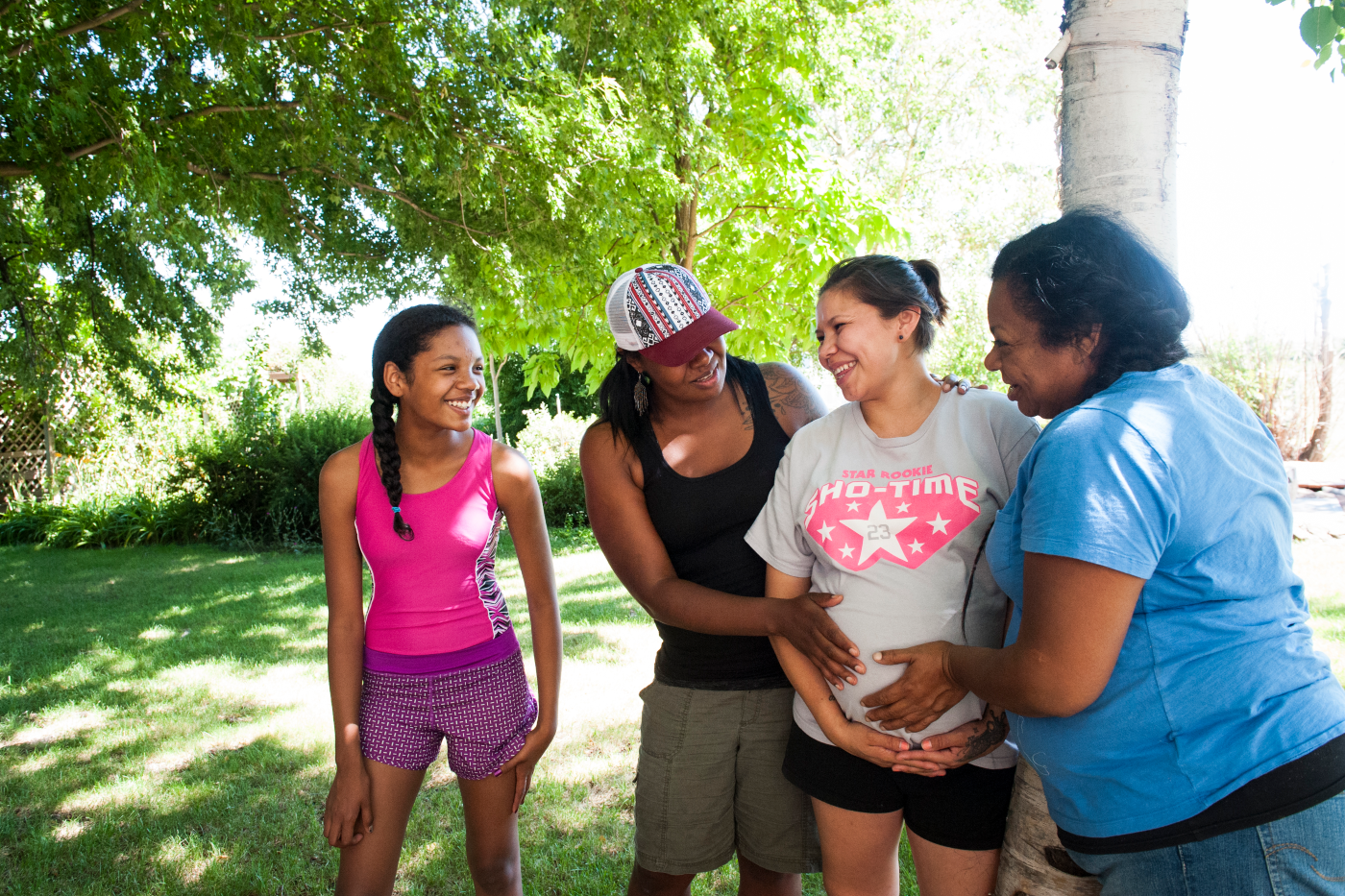
Ttáwax̲t Birth Justice Center grew from people coming together, people who shared a deep care for their community. Each of our founding staff members were already doing work to support local families, and their paths crossed through that shared purpose. In those early connections, the seeds that would grow into Ttáwax̲t were planted.
The Landscape
In 2012, while working at Yakima Memorial Hospital on a needs assessment, Jessica “Jess” Whitehawk observed that infant mortality rates were historically high, nationwide but especially in Yakima County. Although rates for other racial groups in the county were improving, those for American Indian and Alaska Native (AIAN) families were worsening.
As an Indigenous woman living on the reservation, Jess recognized that these disparities were deeply connected to systemic racism, historical trauma, inequities in care, access, and the lack of resources needed to thrive. She began conversations with people from Indian Health Service, community members, and local providers about these alarming trends and what was being done to address them.
Unfortunately, very little was being done at the time — and the blame was placed on birthing people themselves, rather than on the system.
Community Needs Assessment
In response to this, Jess brought together a coalition of community members and service providers to investigate and better understand the issue. Together, the coalition designed a community needs assessment to uncover the realities behind the high infant mortality rates. This assessment included both surveys and interviews.
During this process, Jess met Semone “Moni” Dittentholer (who would eventually become a fellow Ttáwax̲t founding staff member) while seeking surveyors to help gather data. Moni, trained as a research assistant, joined the effort and began collecting data. Leslie Swan (another founding staff member) participated as one of the community respondents.
Once the results were in, the coalition identified several key themes contributing to the disparities:
- Lack of transportation
- Medical racism
- Limited access to quality care
- Unplanned pregnancies
- Need for stronger support systems
They also found that families who had strong matriarchal figures in their lives experienced no infant mortality.
2014 and Beyond
Ttáwax̲t began providing direct services at Campbell Farm in 2014. At that time, Carmanita “Carman” Pimms was the director of Campbell Farm and was centered in community. She was already a doula and supported Ttáwax̲t by giving us a space on the farm to do birth justice work. Carman became another founding staff member of Ttáwax̲t and with her co-leadership, Ttáwax̲t formally became a 501(c)(3) nonprofit organization in 2019.
Since then, we have stood by our clients and community members with thousands of visits and hundreds of births, offering culturally grounded care and support.
In 2022, Ttáwax̲t conducted another needs assessment, during which community members shared their birth experiences. Approximately 97% of our respondents expressed interest in having a birth center on the reservation, along with many other findings.
Today, guided by what we learned, we are now exploring ways to expand our mission and deepen our impact. One of the ways we are doing this is through fundraising for and developing a Wellness Campus & Birthing Center, as well as through other community-centered initiatives.
Honoring Our Ancestors
We miss and honor Carmanita Pimms (June 16, 1963–Aug. 21, 2021, Yakama), and Levina “Kussamwhy” Wilkins (December 23, 1936–September 2, 2024, Yakama). Carman was Campbell Farms’ executive director and a Ttáwax̲t co-founder and birth justice advocate. Levina was one of our elders, Leslie Swan’s mentor, and an Ichiishkin language teacher. She also created and taught the “Virtues of the Yakama People,” which Ttáwax̲t uses to guide many services.
Carman and Levina’s strength and wisdom are woven into Ttáwax̲t and continue to inform our work.